

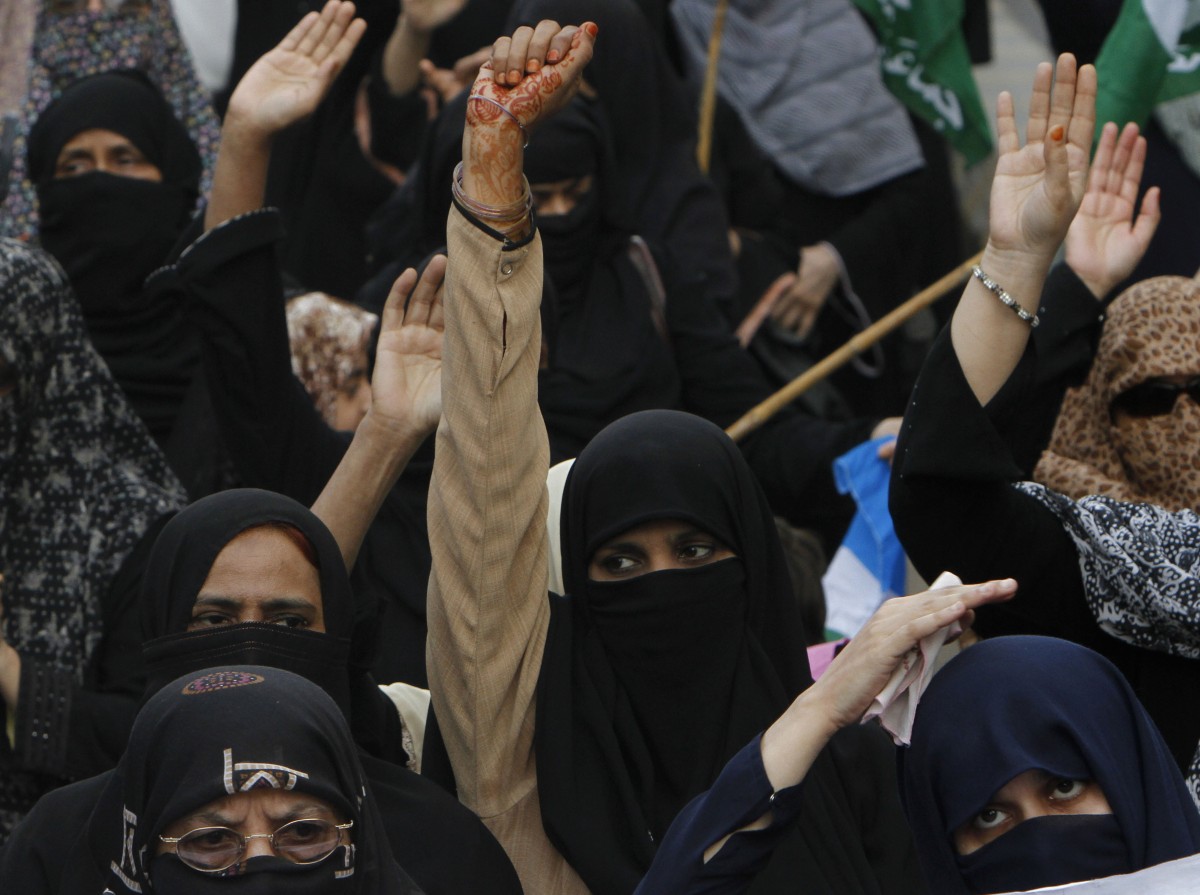

A French teenager attempted suicide this week after being attacked by Nazi skinheads who targeted her for wearing the Islamic veil. The incident is the latest in an ongoing national debate on French laws banning citizens from wearing obvious religious symbols in public schools and face coverings in public spaces.
The debate over veiling in France has been brewing for decades, but the first formal laws addressing religious attire date to a 2004 ban on religious symbols in public schools.
President Nicolas Sarkozy sought to expand the laws by prohibiting face coverings in 2009, declaring “the burqa is not welcome in France.”
France 24 International News reports that the 16-year-old girl had filed charges against two individuals she accused of carrying out an Islamophobic attack against her on August 12. Police reports indicate that two men approached the girl with a “sharp object,” ripped off her headscarf, and shouted Islamophobic insults. After they hit her on the shoulder, they fled by car.
In the following days, the girl, who was not named in the report, attempted to take her own life two separate times, first by ingesting a large quantity of prescription drugs and later by jumping from the fourth floor of her apartment building outside Paris. She survived both suicide attempts.
Regardless of the outcome in this case, religious freedom and inclusion have become major issues for religious French citizens, including France’s five million Muslim citizens, many of whom are immigrants hailing from former French colonies in North Africa.
The incident isn’t an isolated one. There has been intense public debate and violent confrontations when those who wear religious garb are confronted by community members. In one recent incident in July, the town of Trappes witnessed three nights of violent clashes following an altercation.
That incident started after police questioned a woman who was wearing the full-face veil, in violation of current French laws. The woman’s husband intervened and was subsequently restrained and arrested, sparking an outcry from locals who then attacked a police station.
The current laws banning religious dress in public dates to former French President Nicolas Sarkozy who took up the fight to ban the burqa and other Islamic head coverings in 2009.
« The problem of the burqa is not a religious problem, it’s a problem of liberty and women’s dignity,” Sarkozy said. “It’s not a religious symbol, but a sign of subservience and debasement. I want to say solemnly, the burqa is not welcome in France. In our country, we can’t accept women prisoners behind a screen, cut off from all social life, deprived of all identity. That’s not our idea of freedom. »
France is a predominantly secular country and opinion polls taken shortly after the law was passed in 2011 found that 82 percent of the French public was supportive of banning full veils that cover the face, head and neck, according to one Pew Research Center Poll.
This law expanded upon 2004 legislation that bans the wearing of all conspicuous religious symbols in public schools including: niqabs, burqas and other forms of veils worn by religious Muslim women.
There are also restrictions on other types of religious garb, including Jewish “kippah” skullcaps and crucifixes. Those who violate the ban are given a small fine, but individuals who wear the veil for religious reasons say that the punishment is much larger, preventing some from obtaining or maintaining employment.
Fatima Afif was fired from her job five years ago for refusing to remove her veil while working at the private Baby Loup nursery school. Since the school is private, Afif claimed that she was not violating laws that apply only to public schools and public spaces. The top court in France supported her claim, finding in March that she was the victim of religious discrimination.
The debate restarted in April when France’s President Francois Hollande, a Socialist Party politician who was elected last year, appears to have picked up where his predecessor left off, calling for broader restrictions on religious dress in April.
« When there is contact with children, in what we call public service of early childhood … there should be a certain similarity to what exists in (public) school,” Hollande said during an interview on national television. « I think the law should get involved. »