

In a decision that digital rights advocates called « a groundbreaking victory for Americans’ privacy rights, » the U.S. Supreme Court ruled on Friday that police generally must obtain a warrant before collecting cellphone records that can be used to track a person’s movements.
The American Civil Liberties Union (ACLU), which represented the petitioner, predicted the « historic » win « will have a ripple effect for privacy, » particularly as it applies to data held by third parties. As the group explained in a series of tweets, « It will help protect all sorts of digital information stored online, from emails to data from smart home appliances. »
Starting now, the government can no longer claim that just using technology like your cellphones means you've given up your Fourth Amendment rights. This is huge. #GetAWarrant pic.twitter.com/iIXvODUKpX
— ACLU (@ACLU) June 22, 2018
Nate Freed Wessler, the ACLU staff attorney who argued the case, discussed the ruling and what it could mean for future cases in a short video posted on Twitter:
ACLU attorney @NateWessler explains what today's major Supreme Court victory on cellphone location tracking means for your privacy rights. pic.twitter.com/S1i9H0Fuk7
— ACLU (@ACLU) June 22, 2018
Famed government whistleblower Edward Snowden tweeted the decision was a « victory for ACLU—and America. »
The Supreme Court just ruled the government's decades-old practice of warrantlessly tracking your historical movements via cellphone records (CSLI) has in many cases violated the constitutional right to privacy. Major victory for @ACLU ― and America. #GetAWarrant #Carpenter pic.twitter.com/lqm4joMysm
— Edward Snowden (@Snowden) June 22, 2018
Chief Justice John Roberts—joined by Ruth Bader Ginsburg, Stephen Breyer, Sonia Sotomayor, and Elena Kagan—wrote the majority opinion (pdf), which explained: « Cellphones perform their wide and growing variety of functions by continuously connecting to a set of radio antennas called ‘cell sites.’ Each time a phone connects to a cell site, it generates a time-stamped record known as cell-site location information (CSLI). Wireless carriers collect and store this information. »
The case in question involved Timothy Carpenter, who was sentenced to serve more than 100 years in prison for multiple robberies in Michigan and Ohio. With a court order that has a lower standard than a warrant, investigators obtained more than four months of location records from Carpenter’s cellphone company, and used that information to build a case against him.
Considering that CSLI data « is detailed, encyclopedic, and effortlessly compiled, » and that « individuals have a reasonable expectation of privacy in the whole of their physical movements, » the court determined that « the government will generally need a warrant to access CSLI » to comply with the Fourth Amendment.
The narrow ruling, Roberts noted, does not apply to « other business records that might incidentally reveal location information » or « other collection techniques involving foreign affairs or national security. » He added that warrantless searches still may be conducted under « exigent circumstances. »
The Constitution Project called the ruling a « long-overdue advance for privacy rights » but also accused the court of « taking baby steps as tech sprints ahead. »
2/ SCOTUS needlessly punted on location tracking with real-time records, though the privacy impact is effectively the same. Citing our brief w/ @EFF, @BrennanCenter & more, SCOTUS noted that evolving tech means they’ll need to look at this in the future: https://t.co/0AxkIKLmNL pic.twitter.com/WibjK3qYLw
— The Constitution Project (@ConPro) June 22, 2018
The high court’s other four conservative justices—Samuel Alito, Neil Gorsuch, Anthony Kennedy, and Clarence Thomas—each wrote dissenting opinions. The ruling on Friday follows a 2014 decision in which the justices unanimously determined that police must obtain a warrant before they can search the cellphone of an arrested person.
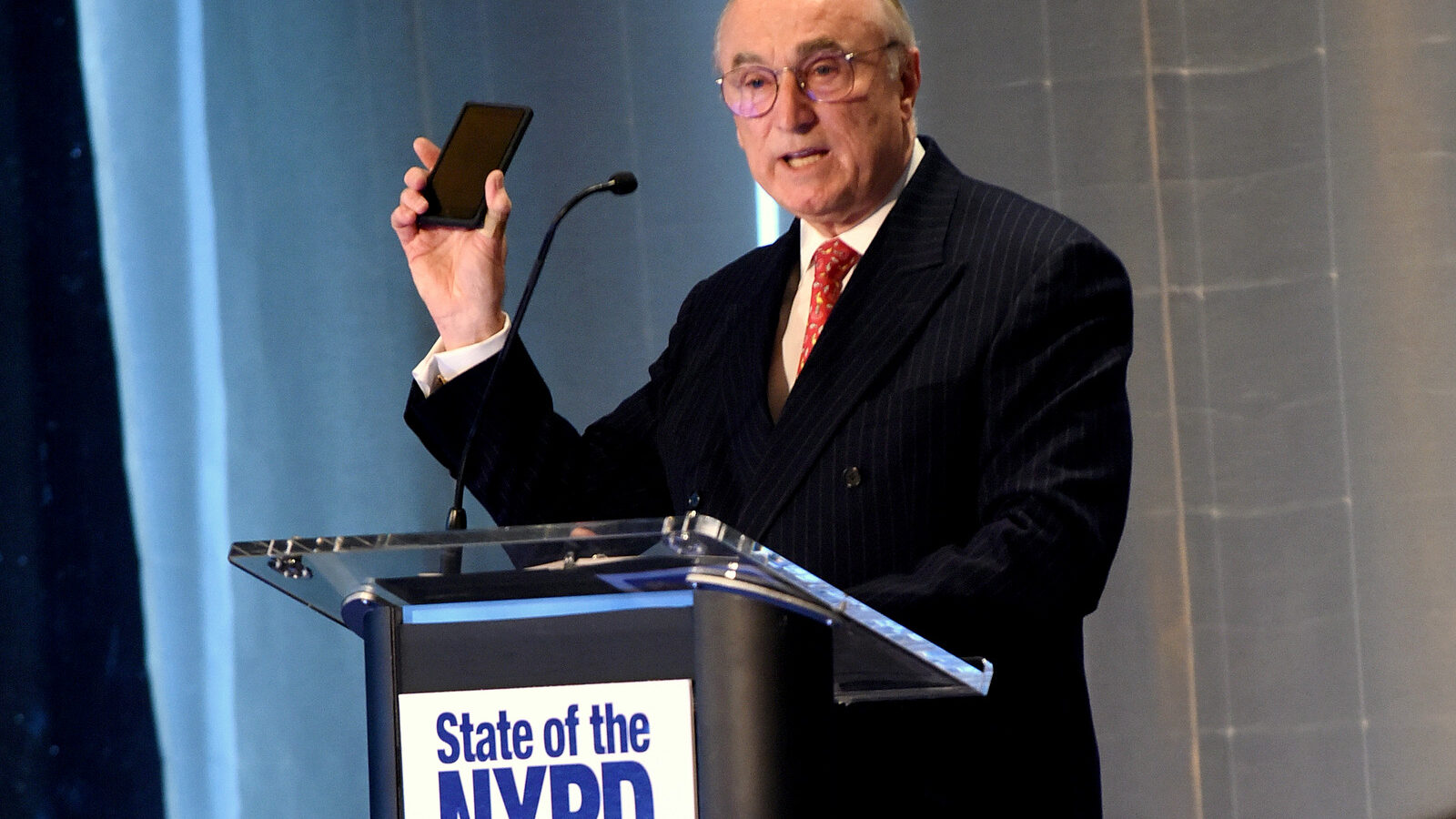
Top Photo | New York City Police Commissioner William J. Bratton announces that every police officer will be equipped with a smart phone by March 2016 during the New York City Police Foundation’s « State of the NYPD » breakfast, Wednesday, Jan. 20, 2016, in New York. (Diane Bondareff/AP)
 Common Dreams is licensed under a Creative Commons Attribution-NonCommercial-ShareAlike 3.0 International License.