

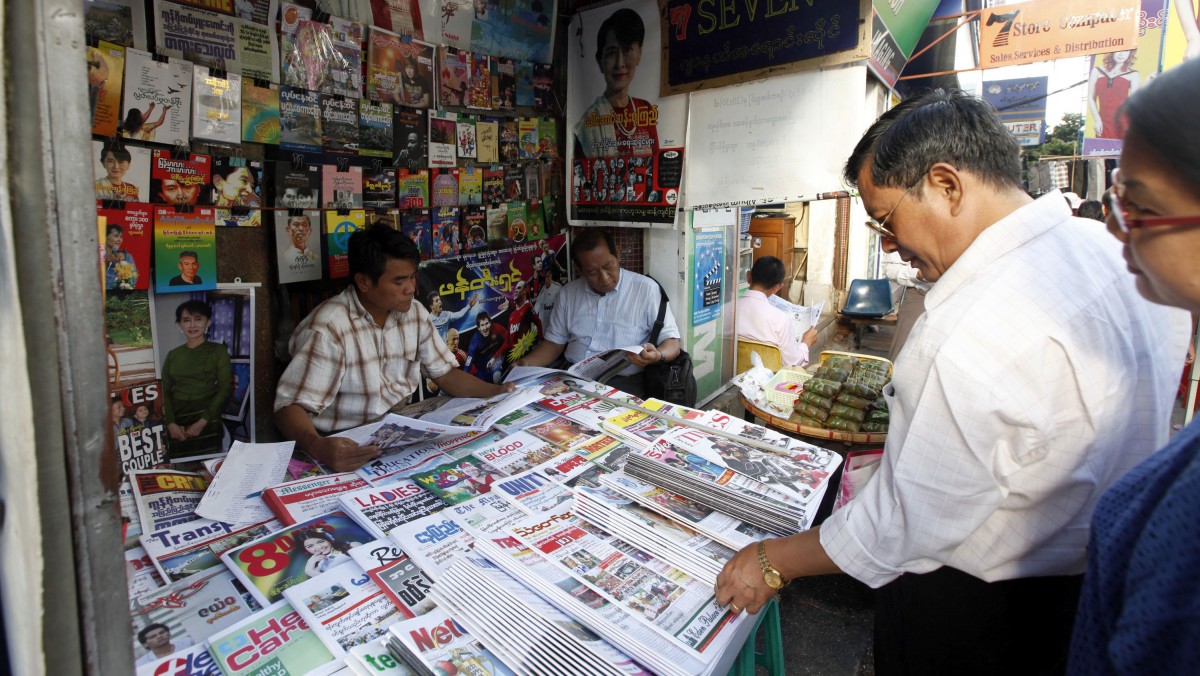

Myanmar said Friday it will allow private daily newspapers starting in April for the first time since 1964, in the latest step toward allowing freedom of expression in the long-repressed nation.
The Information Ministry announced on its website that any Myanmar national wishing to publish a daily newspaper will be able to submit an application in February. New papers will be allowed to begin printing April 1 in any language.
The move was an expected part of new press freedoms President Thein Sein has introduced as part of wider democratic reforms since taking office last year, after a half-century of military rule.
In August, the government abolished direct censorship of the media and informed journalists they would no longer have to submit their work to state censors before publication as they had for almost half a century.
Myanmar has state-run dailies which serve as government mouthpieces and more than 180 weeklies, about half of which cover news while the rest feature sports, entertainment, health and other subjects.
Private dailies in Burmese, English, Indian and Chinese languages were once vibrant in the former British colony, previously called Burma. But all were forced to close when late dictator Ne Win nationalized private businesses in 1964.
Under Ne Win’s one-party Socialist government the standard of newspapers diminished to propaganda sheets. The most recent military regime ruled by Gen. Than Shwe used the country’s three state-owned dailies as junta mouthpieces, which continue to be unpopular with low circulation.
Until just two years ago, this Southeast Asian nation’s reporters were regarded as among the most restricted in the world, subject to routine state surveillance, phone taps and intense censorship. The censorship board would shut down newspapers temporarily for violations. Journalists were tortured, imprisoned and subjected to constant surveillance.
Testing their new freedoms, journalists and private publications have become bolder. They have printed once forbidden items including pictures and stories about anti-government demonstrations and sectarian violence. The once highly taboo images of opposition leader Aung San Suu Kyi are now often displayed, even in state-controlled media.