
VATICAN, Italy (MintPress) — In an effort to forge a friendship and mutual religious understanding, amidst tense political relations between their home countries, American Christian and Iranian Muslim scholars met recently at the Vatican in Rome, Italy.
Seven members of the theology faculty of Al-Mustafa University in Qom, Iran and four members of the theology department at the University of St. Thomas in St. Paul, Minn., met in June at the Monastery of Sant’Anselmo in Rome, to discuss aspects of “Religion and Spirituality in Life and Society.”
Bumpy road in organizing a meeting
In an interview with MintPress, Dr. Terence Nichols, professor of theology and co-director of the Muslim-Christian Dialogue Center at the University of St. Thomas, explained that “a series of unusual events” led up to the meeting between the two groups of scholars, who had never met before the conference.
“In January, Dr. Taher Golestani had sent out an email to many Catholic theologians, informing them that he had started a movement in Qom, which he called M.C.I.D., for Muslim-Christian Interfaith Dialogue. Very few answered this email, and some of the responses were hostile. However, because we had started a very similar center at St. Thomas, I thought it important that our two movements get together. So I answered his email. This led to a long email correspondence, which in the end led up to the meeting in Rome.”
Golestani, disappointed by a lackluster response to his original message sent another email out, asking his Christian counterparts, “I have sent the email of invitation to many Catholic churches and Christians as you see in the address bar, but they did not join us or at least to send the letter of rejection, WHY?! Since I am not that much acquainted with the Christian atmosphere, would you please tell me what is the problem?”
Nichols did answer that email, after Laurie Dimond, his departmental assistant urged him to reply.
“I thought, we ought to get together, we are doing the same thing,” Nichols said. In his response to Golestani, Nichols wrote, “God knows that we need Muslim-Christian dialogue more urgently than ever.”
Then the two began a dialogue — exchanging more than 100 emails in preparation for a planned symposium to exchange ideas. Nichols was aided in making the preparations by one of the members of the Board of Directors at the Muslim-Christian Dialogue Center, Professor Odeh Muhawesh, a graduate of one of the seminaries in Qom and also an instructor on Islam and Middle Eastern studies at St. Thomas.
US-Iranian relations strained, yet some see path to peace
“I believe that in today’s situation, which we witness challenges of religions and civilizations, this is our duty to enhance the global peace and peaceful coexistence. We, religious people, have a heavy burden on our shoulders in this regard,” Golestani said in an interview with MintPress, speaking on his motivations in organizing the conference.
Relations between the U.S. and Iran have become increasingly strained in recent months, as the U.S. and Israel have alleged that Iran is developing nuclear weapons.
Iran has maintained that they are just developing enough nuclear power for peaceful purposes such as power and medical research.
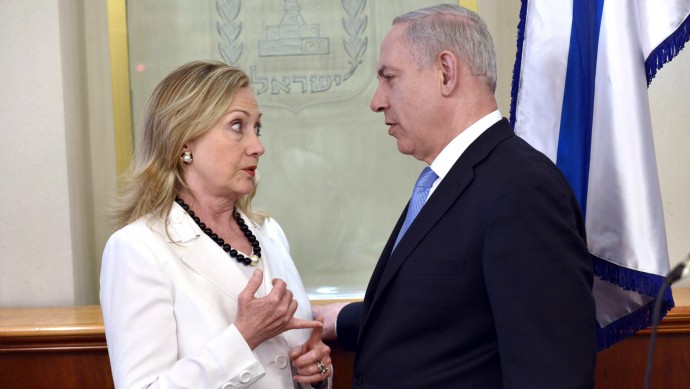
Secretary of State Hillary Clinton visited Israel recently, where she met with Israeli Prime Minister Benjamin Nethanyahu, who said he was eager to hear reassurances of the U.S. that they would maintain commitments to help insure that Iran does not develop a nuclear weapons program.
“We will use all elements of American power to prevent Iran obtaining a nuclear weapon, » Clinton told reporters at a press conference in Jerusalem.
« I think it is fair to say we are on the same page at this moment, trying to figure our way forward to have the maximum impact on affecting the decisions that Iran makes. »
MintPress recently reported that Netanyahu has said he will attack Iran if they develop nuclear weapons.
Previously during nuclear talks in Istanbul last month, the P5+1 insisted that Iran stop uranium enrichment above 20 percent, close an underground nuclear facility near the city of Qom and export uranium enriched above 20 percent. The P5+1 is comprised of the permanent U.N. Security Council: China, France, Russia, the U.K. and the U.S., plus Germany. Iran recently agreed to halt uranium enrichment above 20 percent and agreed to “operationalize” the Supreme Leader’s fatwa against nuclear weapons. Iran has insisted, however, that the U.S. and EU lift sanctions. Additionally, Iran has insisted that the West accept the country’s right to enrich uranium below 20 percent, for peaceful purposes.
But the U.S. and the European Union have imposed sanctions on Iran, which continue to have a devastating effect on the country’s economy and its people.
Timely conference
One of the first challenges the two groups faced in arranging a meeting was the question of where to meet.
“Arranging the meeting was difficult; it was hard to find a place to stay and to meet, hard to get visas for the Iranians, many delays, and so on,” Nichols said.
The group was hosted by the Benedictine monks at Sant’Anselmo in Rome, who offered to house the participants at their abbey near the Vatican.
St. Thomas has a campus in Rome, which was the first choice selected for the event, but as Nichols explained, a high volume of events scheduled in advance there did not make it a feasible option.
Rome is significant to Catholics, as it is the city where the Pope, the head of the Catholic church, resides, and many theological matters are discussed and decided upon there. As the Catholic Encyclopedia points out, “It is here that the history of the Church can be traced from the earliest days, from the humble beginnings in the Catacombs to the majestic ritual of St. Peter’s. At every turn one comes upon places hallowed by the deaths of the martyrs, the lives of innumerable saints, the memories of wise and holy pontiffs. From Rome the bearers of the Gospel message went out to the peoples of Europe and eventually to the uttermost ends of the earth. To Rome, again, in every age countless pilgrims have thronged from all the nations, and especially from English-speaking countries.”
Qom is also significant to many Muslims, especially those of the Shiite tradition, which is the second largest denomination of Islam.
Like all Islamic traditions, Shiite Islam is based on the teachings of the Quran and the message of the Islamic Prophet Muhammad. In contrast to other types, Shiites believe that only God has the right to choose a representative to safeguard Islam, the Quran and sharia. Thus the Shiites look to Ali, Muhammad’s son-in-law, whom they consider divinely appointed, as the rightful successor to Muhammad and the first leader of the Muslim community after the prophet’s death in the seventh century.
The School of Qom, where the Iranian delegation was from, refers to the tradition of theological institutions of Shiite learning in Qom, a city in southern Iran. Along with Meshhad in north eastern Iran and Karbala and Najaf in Iraq, Qom is a major center for Shiites. Qom remains the major center of academic Shiite research and religious study.
Proceedings and presentations
Presentations in Rome were given each day by scholars from camps and from the Rev. Ivan Sokolowski, a Jesuit from the Cardinal Koenig Institute in Vienna, on interreligious dialogue. The American scholars gave presentations, including Nichols, who presented a paper on the first day of the event titled, “Muslim-Christian Dialogue: Challenges and Possibilities,” which examined the Catholic background for Muslim-Christian dialogue.
 Nichols also discussed what he viewed as the aims of interfaith dialogue, including mutual understanding, common action, sharing of life and religious experiences. “But, more profoundly, a deeper conversion of each other to God, and finally, that Muslims and Christians, rather than trying to convert each other to their own faiths, might stand together as common witnesses to the One God whom they both worship,” a summary of the paper explained.
The language presentations by American scholars were given in English. “But most of what we said had to be translated into Arabic or Persian,” Nichols said.
Another presentation, by Ayatollah Gharavian of Al-Mustafa University in Qom was given the same day on a paper he authored entitled, “Peace and Peaceful Co-existence.” In the paper, he explained, “Islam’s main and global invitation is to peace and serenity … the Quran wants all nations and societies to live with each other in complete peace and to act according to humane and ethical values such as mutual respect and observing other peoples’ rights.”
“The experiential knowledge was valuable,” said Muhawesh, shedding light on the significance of the event. “They [the scholars from Mustafa International University ] read a lot of books, so it was valuable to come together and learn from each other in person.”
“The event was really fruitful and successful. I, personally, fell in love with the good and intimate relations that our dear Catholic brothers had with us,” Golestani said.
And the American scholars were equally as optimistic. Dr. Michael Hollerich, who teaches in the theology department at the University of St. Thomas, said one Iranian scholar he met at the conference told him he read the New Testament everyday “and more than the Quran!,” Hollerich said.
“If all theology agreed on everything, we’d have one religion, and that would be very boring,” said Dr. Bernard Brady, Chair of the theology department at St. Thomas University. “The Bible and Quran do share a similar cast of characters, but they do and say different things,” he explained.
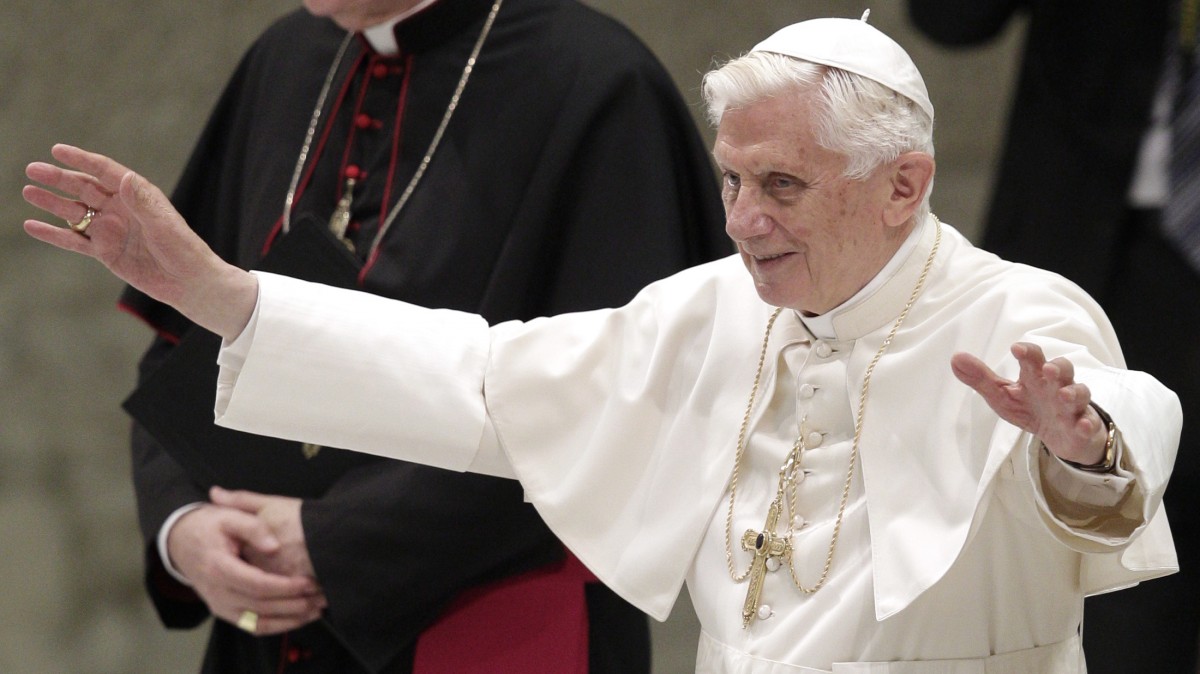
The groups also attended a Catholic religious service, the Feast of Corpus Christi, together in Vatican City, which was led by Pope Benedict XVI.
Brady said his Muslim counterparts were “genuinely interested” in the service and asked questions throughout. “I felt like a color commentator,” he said. “Never in my life did I think I would be standing at the Vatican, chatting and joking with an ayatollah. We met good, gracious, smart, friendly devout people.”
Impact of the event
Brady said he learned a lot of Islam, and the scholars from Qom learned a great deal about Christianity.
Near the end of the conference, the group was met by Monsignor Khaled Akasheh, the Head Officer for Islam at the Pontifical Council for Interreligious Dialogue. He explained the role of the Council for Interreligious Dialogue, which promotes inter-religious dialogue in accordance with the spirit of the Second Vatican Council, a religious scholarly series of meetings which took place in the early 1960s and addressed relations between the Roman Catholic Church and the modern world. The document Nostra Atatae, Latin for “In Our Time” was crafted at that meeting and has become a foundational text for Catholics seeking to do interfaith. The document decreed that one of the goals of the Catholic Church ought to be to promote mutual understanding, respect and collaboration between Catholics and the followers of others religious traditions, to encourage the study of religions and to promote the formation of persons dedicated to dialogue.
“Vatican II says that Catholic universities ought to be in dialogue with other religions and cultures,” Brady said, adding that moving forward, the scholars from his department will work to educate the campus and larger community about “what’s at stake in Muslim-Christian dialogue, what it’s about, the commonalities and misunderstandings.”
The two groups of scholars, American and Iranian, have plans to continue their dialogue, which may include scholars from Iran coming to St. Thomas, or the American scholars visiting Qom.