

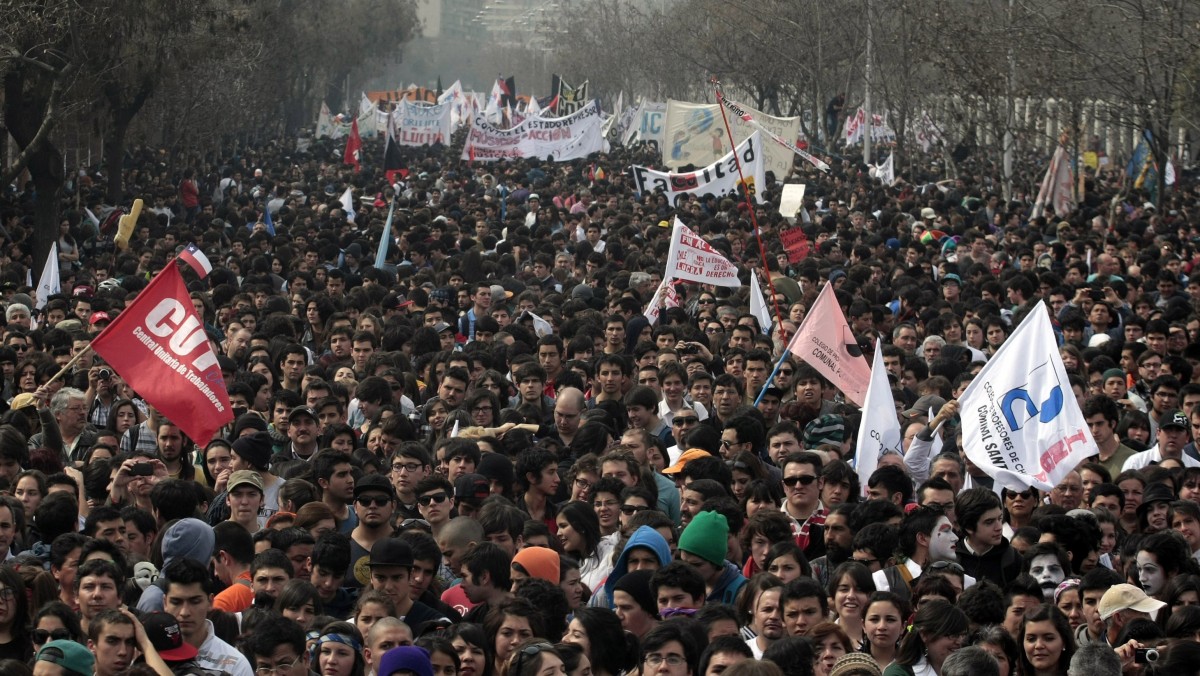

(MintPress) – Sixty percent of Chile’s 13 million registered voters abstained from casting a ballot in municipal elections last week, a clear sign of discontent that could be a harbinger of overall voter discontent one year before the 2013 presidential elections. Chilean President Sebastian Pinera says that the mass abstentions are a “warning sign that should be heeded.” However, with less than a 30 percent approval rating, Pinera will have to take drastic steps to restore public confidence in his leadership ahead of next year’s elections.
Pinera, a billionaire politician representing a center-right coalition, has drawn the scorn of university students protesting tuition increases and austerity measures that have led to the disintegration of a once strong social safety net. For Chileans, a vote next year could usher in a new era of liberal political leadership committed to restoring the public vision of universal education for all citizens.
Pinera: Pinochet round II?
Despite only a 40 percent voter turnout, 43 percent of those who did cast ballots chose center-left parties, a direct affront to Pinera’s ruling center-right coalition which received just 38 percent of the vote.
This poor performance corresponds closely to public opinion polling reflecting a growing disillusionment with the Pinera government. Public support for the current leadership reached a 63 percent high October 2010, just after the successful rescue of 33 trapped miners.
However, public disillusionment charged by the student movement has led to sharp decreases in the president’s overall popularity. According to an April opinion poll, just 29 percent of the Chilean public now approve of the president’s performance.
Pinera’s sharp decrease in popularity amongst the Chilean public stems from the robust student movement. For more than a year, hundreds of thousands of university and high school students have protested Pinera’s policies that continue those of his predecessor, Augusto Pinochet.
Pinochet ruled the South American nation for 17 years under a brutal military dictatorship.
During Pinochet’s rule, an estimated 3,200 political dissidents were murdered or disappeared. Many Chileans harbor deep resentment toward Pinochet while small numbers praise the deceased dictator for leading the country out of deep poverty through liberal economic reform.
The precedent for the current Pinera education policy came from decisions made by Pinochet in 1981, when the government eliminated most funding for higher education and sharply cut funds to secondary schools. As a result, many families chose to purchase costly vouchers to send their children to high school. Many college students were forced to take out costly loans to afford their education.
These policies mirror those widely supported by national policy makers in the U.S. A report published last month by the Office of Budget and Policy Priorities shows 26 states will slash education budgets, spending less per student in fiscal year 2013 than they spent in 2012.
Arizona, Alabama and Oklahoma are expected to see the sharpest single year declines, with cuts averaging more than 20 percent in their respective state education budgets.
Additionally, the U.S. federal government has done little to mitigate the rapidly increasing cost of college tuition. The cost of tuition at public colleges and universities rose 4.8 percent this year to an average of $8,655, according to a Bloomberg News Report. Tuition at private institutions rose 4.2 percent, to an average of $29,056 according to the same study.
These increases outpaced inflation and will likely lead to an increases in the $1 trillion student debt across the U.S.
Richard Seymour, a contributor at the Guardian newspaper, contends that the mass privatization of education that began during the Pinochet era is causing many students to make a difficult choice: accept a burdensome debt or forgo higher education altogether.
“In 1981, the Pinochet regime dismantled free public education. Primary and secondary education is paid for by a vouchers system, which involves the government paying private sector providers to educate the young.”
Seymor adds, “Higher education is dominated by private professional and technical colleges, which cost up to £530 a month to attend. The state exists primarily as a regulator rather than a provider. As a result, working-class Chileans often receive at best a poor education, and students end up burdened with debts.”
The student movement remains relevant
Students in Chile, like those in Quebec, have responded to these conditions with a clear message demanding free, universal education for all citizens as a human right, not a privilege reserved for the wealthy.
Chileans have likely drawn inspiration from the successes of the Quebec student movement. Sustained public protest by the Quebecois student movement successfully halted plans to increase tuition at colleges and universities across the province earlier this year.
Although demonstrations and occupations across Chile have shrunk considerably in size commensurate with the police crackdowns, the movement has maintained a sizable public presence, influencing public opinion of the president and his current economic policies.
The government announced a decision earlier this summer to raise $ 1 billion in taxes for public education and an additional $1 billion for new student scholarships. However, leaders of student unions believe that the offers are insufficient and do not address the underlying problems of rapidly increasing tuition fees.
This point was confirmed in an April article titled, “Chile: Progress and its Discontents.” The Economist wrote, “Fees at most universities cluster at the upper end, irrespective of quality. And on average, they have been rising by 3-4 percent a year in real terms in the past 15 years.”
Although the students remain steadfast in their commitments to universal higher education, the government rejects the assertion that education should be free and available to all citizens.
Andres Chadwick, a cabinet secretary in Mr. Pinera’s administration, commented, saying, “Free education doesn’t seem fair to us, because those in higher education still tend to be the better-off.”
Public disillusionment with neoliberal capitalism
The plight of students and the overall public dissatisfaction with the current economic policies of the current government are inextricably linked to a growing rejection of neoliberal capitalism and mass privatization of industry.
Despite having an advancement economy and a 6.6 percent unemployment rate, one of the lowest in Latin America, the privatization of education and deregulation of markets has led to a growing public disillusionment with status quo, Pinochet era reforms.
Chile is now the most “unequal country” in the Organization for Economic Cooperation and Development (OECD), an economic bloc of 34 advanced countries that includes the U.S., the U.K., Turkey and Japan, among others.